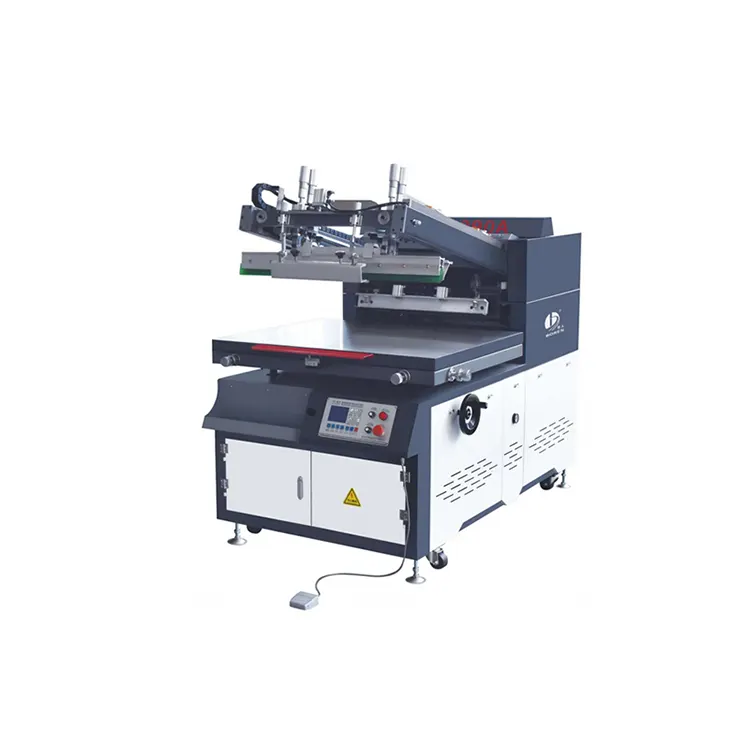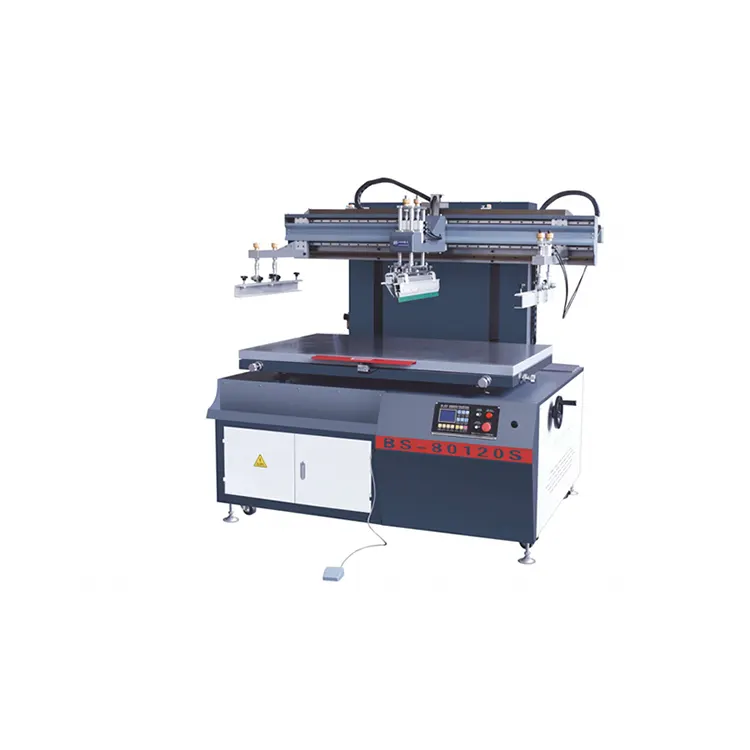

For manufacturers seeking consistent quality, flexible production and efficient flat-surface printing, Green Ohm provides the Microcomputer Controlled Flat Lift Screen Printing Machine with a semi-automatic structure, microcomputer control, vacuum adsorption and variable-frequency drive technology. With printing speeds of up to 1,100 prints/hour depending on the model, this equipment is designed for demanding industrial applications.
A modern flat screen printing system needs more than basic printing movement. It must provide stable positioning, controlled printing pressure, consistent ink distribution and practical operation. The Microcomputer Controlled Flat Lift Screen Printing Machine combines an LCD-based microcomputer control system with electric variable-frequency lifting and printing transmission, pneumatic scraper control, vacuum platform adsorption and adjustable alignment functions. Green Ohm offers three models—BS-5070S, BS-6090S and BS-80120S—with maximum printing areas from 500 × 700 mm to 800 × 1200 mm and maximum speeds from 900 to 1,100 prints/hour. This makes the machine suitable for advertising products, acrylic, metal sheets, circuit boards, film switches, ceramic paper, self-adhesive labels, cards, wooden boxes and other flat materials.
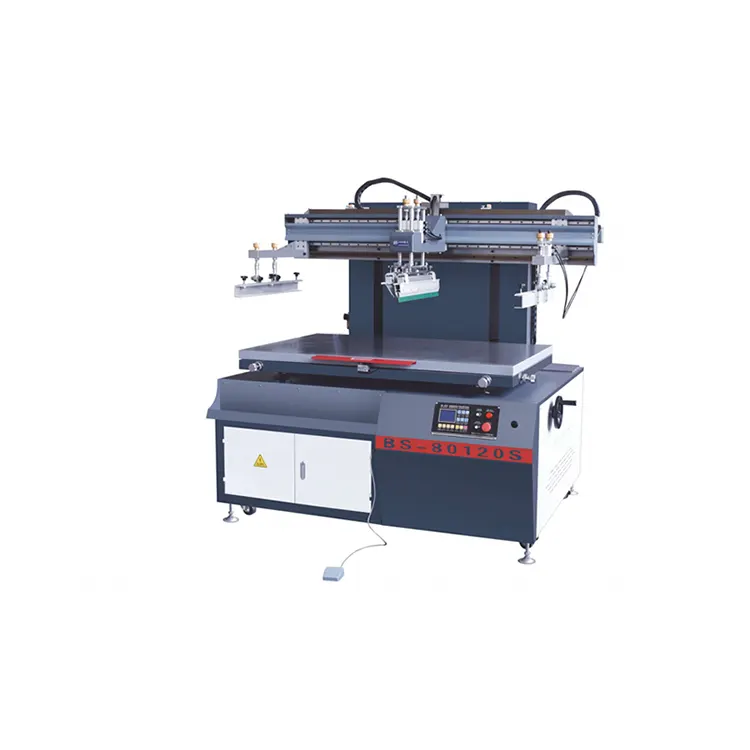
Table of Contents
- What Is a Microcomputer Controlled Flat Lift Screen Printing Machine?
- What Are the Key Features of the Machine?
- What Are the Main Technical Specifications?
- Which Materials and Applications Can It Handle?
- How Does It Improve Printing Efficiency?
- How Should Buyers Select the Right Model?
- What Should Operators Consider During Operation?
- Frequently Asked Questions
- Why Consider Green Ohm for Flat Screen Printing Equipment?
What Is a Microcomputer Controlled Flat Lift Screen Printing Machine?
A Microcomputer Controlled Flat Lift Screen Printing Machine is a semi-automatic screen printing system designed for printing graphics, text and patterns on rigid or flat substrates. Unlike basic manual equipment, the machine integrates electronic control, mechanical lifting, variable-frequency speed adjustment and pneumatic blade operation into one production system.
The machine uses a straight-arm lifting structure. The screen moves through a controlled lifting process while the printing stroke runs from left to right. A microcomputer control system with an LCD display allows operators to manage key operating functions more conveniently.
During printing, the vacuum platform firmly holds the workpiece in position. This helps reduce unwanted movement during the printing stroke and supports more consistent registration. The machine also uses adjustable alignment functions so operators can fine-tune the relationship between the screen, substrate and printing platform.
According to Green Ohm's published specifications, the system is designed for high productivity while maintaining smooth operation and positioning accuracy. The available models cover several production sizes, allowing users to match equipment capacity with their actual printing requirements.
What Are the Key Features of the Machine?
Microcomputer LCD Control
The integrated microcomputer control system uses an LCD display and an operation-oriented interface. This design makes machine settings easier to monitor and adjust during production while reducing dependence on complicated manual controls.
Variable-Frequency Lifting and Printing
Electric variable-frequency control is applied to both the lifting mechanism and printing transmission. This allows smoother speed adjustment and controlled reciprocating movement for printing and ink return. Stable movement is particularly important when production requires repeatable printing quality over extended cycles.
Pneumatic Scraper and Ink Blade Control
The scraper and ink blade use pneumatic control with independent pressure adjustment. A secondary pneumatic lifting function also facilitates screen plate replacement and tool disassembly, helping simplify routine setup work.
Vacuum Adsorption Platform
The automatic vacuum adsorption platform holds flat workpieces securely during printing. Combined with a fine-adjustment handle for screen alignment, this structure helps operators make practical corrections before production runs.
Safety-Oriented Platform Design
The machine incorporates a safety protection mechanism in the platform area. When the relevant safety position is pressed or stepped on, the platform is designed to rise and return to its original position, providing an additional operational safeguard.
What Are the Main Technical Specifications?
Choosing a screen printing machine should begin with the required printing area, production speed, screen-frame dimensions and available workshop utilities. The following specifications are based on the three models published by Green Ohm.
| Specification | BS-5070S | BS-6090S | BS-80120S |
|---|---|---|---|
| Maximum Printing Area | 500 × 700 mm | 600 × 900 mm | 800 × 1200 mm |
| Maximum Mesh Frame Area | 750 × 1000 mm | 850 × 1200 mm | 1000 × 1500 mm |
| Minimum Screen Size | 500 × 400 mm | 500 × 400 mm | 500 × 400 mm |
| Printing Platform Size | 600 × 900 mm | 700 × 1100 mm | 900 × 1400 mm |
| Fastest Printing Speed | 1,100 prints/hour | 1,000 prints/hour | 900 prints/hour |
| Working Air Pressure | 5–8 | 5–8 | 5–8 |
| Power Supply | 380V / 2.25 kW | 380V / 2.65 kW | 380V / 3.7 kW |
| Overall Weight | 520 kg | 560 kg | 600 kg |
| Machine Dimensions | 1300 × 1080 × 1680 mm | 1500 × 1180 × 1680 mm | 1800 × 1380 × 1680 mm |
The three configurations provide a practical range for different flat-product sizes. The BS-5070S focuses on a smaller maximum printing area and higher listed maximum speed, while the BS-80120S provides the largest printing area for larger substrates. Buyers should consider both the workpiece dimensions and the actual production cycle rather than selecting a machine based solely on maximum speed.
Which Materials and Applications Can It Handle?
Flat screen printing is widely used when manufacturers need durable, visually clear patterns on rigid or relatively flat substrates. The machine is designed for a broad range of materials and products, including:
- Paper and cards
- Acrylic and organic glass
- Iron and other metal sheets
- Printed circuit boards
- Film switches
- Ceramic flower paper
- Self-adhesive stickers
- Wooden boxes
- Advertising and promotional products
- Other flat and hard objects
This versatility makes the equipment relevant to manufacturers working across advertising, signage, electronics, packaging, decorative products and industrial components. Before production, however, substrate dimensions, surface characteristics, ink compatibility and screen specifications should be verified for the intended application.
How Does It Improve Printing Efficiency?
1. More Consistent Positioning
Screen printing quality depends heavily on substrate positioning and screen alignment. The vacuum adsorption platform helps secure the workpiece, while fine adjustment functions allow operators to correct alignment before production.
2. Controlled Printing Movement
Variable-frequency transmission allows printing speed to be adjusted rather than relying on a fixed mechanical cycle. This provides greater flexibility when different substrates, inks or printing patterns require different operating conditions.
3. Reduced Manual Intervention
Microcomputer control, pneumatic blade operation and automated vacuum adsorption reduce the number of repetitive manual actions required during production. This can make production easier to standardize between operators.
4. Suitable for Repetitive Production
With listed maximum speeds of up to 1,100 prints per hour, the equipment is designed for production environments where repeatable printing cycles are more important than one-off manual printing.
5. Flexible Product Coverage
Three machine sizes provide different printing-area capacities. Manufacturers can therefore select a configuration according to current product dimensions while considering potential future production requirements.
How Should Buyers Select the Right Model?
Purchasing a screen printing machine should involve more than comparing prices. A structured evaluation can help avoid capacity mismatches and unnecessary equipment costs.
- Confirm the maximum product size: Measure the largest substrate that needs to be printed and compare it with the machine's maximum printing area.
- Check the screen-frame requirement: Make sure the selected model can accommodate the mesh frame dimensions required by your artwork and printing process.
- Estimate real production demand: Maximum printing speed is a reference specification, not necessarily the actual sustained production rate. Include loading, unloading, curing and setup time in capacity calculations.
- Evaluate material compatibility: Confirm that the machine configuration, screen, ink and substrate are suitable for the intended application.
- Review workshop conditions: Check electrical power, compressed-air availability, floor space and machine-access requirements before installation.
- Consider future products: If product sizes are expected to increase, selecting a larger printing platform may provide additional production flexibility.
For example, a manufacturer primarily printing small advertising panels may not need the largest configuration. A company producing larger acrylic sheets or metal panels may benefit from the expanded printing area of the BS-80120S. The appropriate choice ultimately depends on the product portfolio and production workflow.
What Should Operators Consider During Operation?
Consistent results depend on both machine design and operating practices. A practical operating routine should include the following checks:
- Inspect the screen and mesh frame before production.
- Confirm that the workpiece is correctly positioned on the vacuum platform.
- Check screen-to-substrate alignment before starting a production batch.
- Adjust scraper pressure according to the printing requirements.
- Set an appropriate printing speed for the substrate and ink system.
- Keep pneumatic and electrical systems within their specified operating conditions.
- Clean ink residue from relevant printing components after production.
- Periodically inspect guide rails, moving components and pneumatic elements.
These practices can help reduce avoidable registration errors, inconsistent ink transfer and unnecessary downtime. For production teams, standard operating procedures are also useful for maintaining consistent results when multiple operators use the same equipment.
Frequently Asked Questions
What is the maximum printing speed of this machine?
The listed maximum speed varies by model. The BS-5070S reaches up to 1,100 prints per hour, the BS-6090S up to 1,000 prints per hour, and the BS-80120S up to 900 prints per hour. Actual output depends on substrate handling, printing conditions and production workflow.
What materials can the machine print?
The machine is designed for flat materials such as paper, plastic, acrylic, metal sheets, circuit boards, film switches, ceramic paper, self-adhesive stickers, cards and wooden boxes.
Is the machine fully automatic?
No. The published configuration is a semi-automatic screen printing machine. It combines microcomputer control, pneumatic blade functions, variable-frequency transmission and vacuum adsorption while still requiring operator involvement in material handling and production setup.
What is the largest available printing area?
The BS-80120S provides the largest listed maximum printing area at 800 × 1200 mm. Its maximum mesh frame area is 1000 × 1500 mm.
What power supply is required?
The published specifications list a 380V power supply. Power ratings are 2.25 kW for the BS-5070S, 2.65 kW for the BS-6090S and 3.7 kW for the BS-80120S. Buyers should confirm the final electrical configuration before installation.
How does vacuum adsorption help screen printing?
Vacuum adsorption helps hold the flat workpiece securely on the printing platform. Stable substrate positioning can support more consistent screen alignment and reduce movement-related printing errors.
Why Consider Green Ohm for Flat Screen Printing Equipment?
Green Ohm Machinery states that its production approach combines technical research capability, quality testing, a complete production system and supply-chain support. Each machine is checked before delivery, with the published product information emphasizing positioning accuracy, smooth operation, printing consistency and long-term industrial use.
For manufacturers evaluating flat screen printing equipment, the key decision factors are clear: printing area, production speed, screen-frame capacity, substrate compatibility, control functions, platform stability and workshop requirements. The BS-5070S, BS-6090S and BS-80120S provide different capacity levels for manufacturers with different product dimensions and production needs.
If you are planning a new flat screen printing line, replacing existing equipment or comparing machine configurations, learn more about the Microcomputer Controlled Flat Lift Screen Printing Machine and discuss your application requirements with Green Ohm. For model selection, technical specifications and production solutions tailored to your products, contact us today and let Green Ohm help you identify a suitable configuration for your printing operation.